Ever wondered who left that footprint? What kind of berries are those? Or why is that White-tailed Deer white all over? Look no further than your local naturalists, the people at your Geauga Park District whose job it is to help you understand the natural world around you.
Use the form below to submit your question – ideally with a photo (if available), description of sighting (including size) and location of sighting (somewhere in Northeast Ohio) – and you’ll receive an email when a naturalist responds.
Please note that while this form does collect your name and contact information, those items will not be posted with your question, only used in case we need to contact you for additional details.
What have other people been asking lately? Scroll below the form and enjoy some other naturalist Q&As on us!
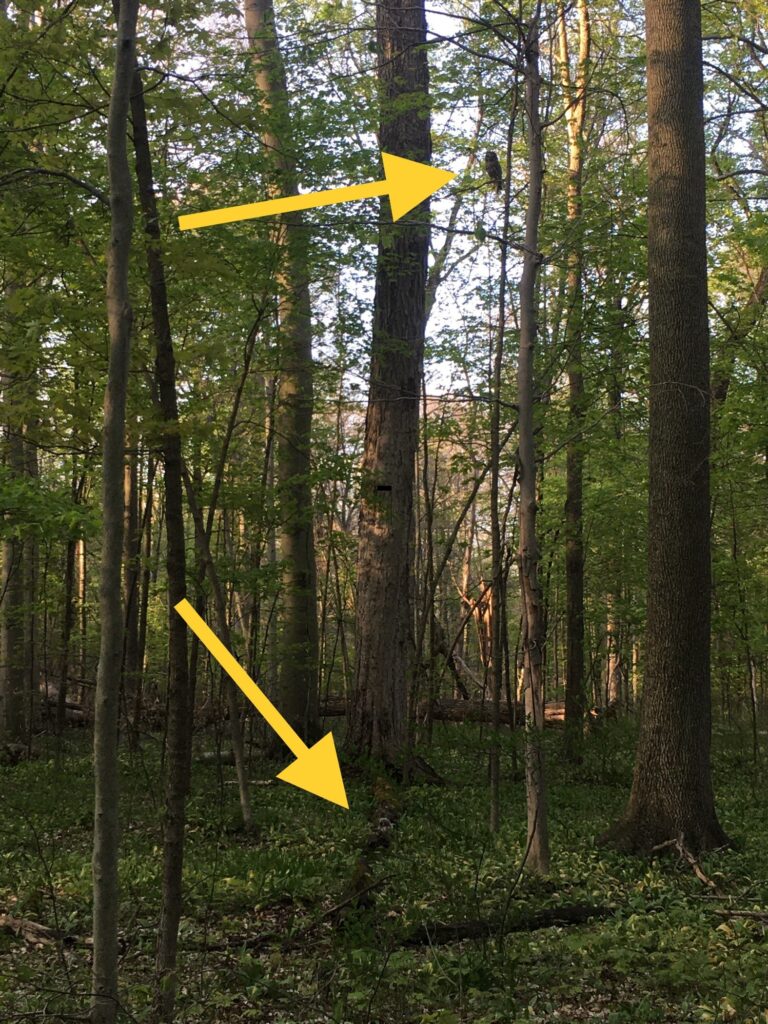
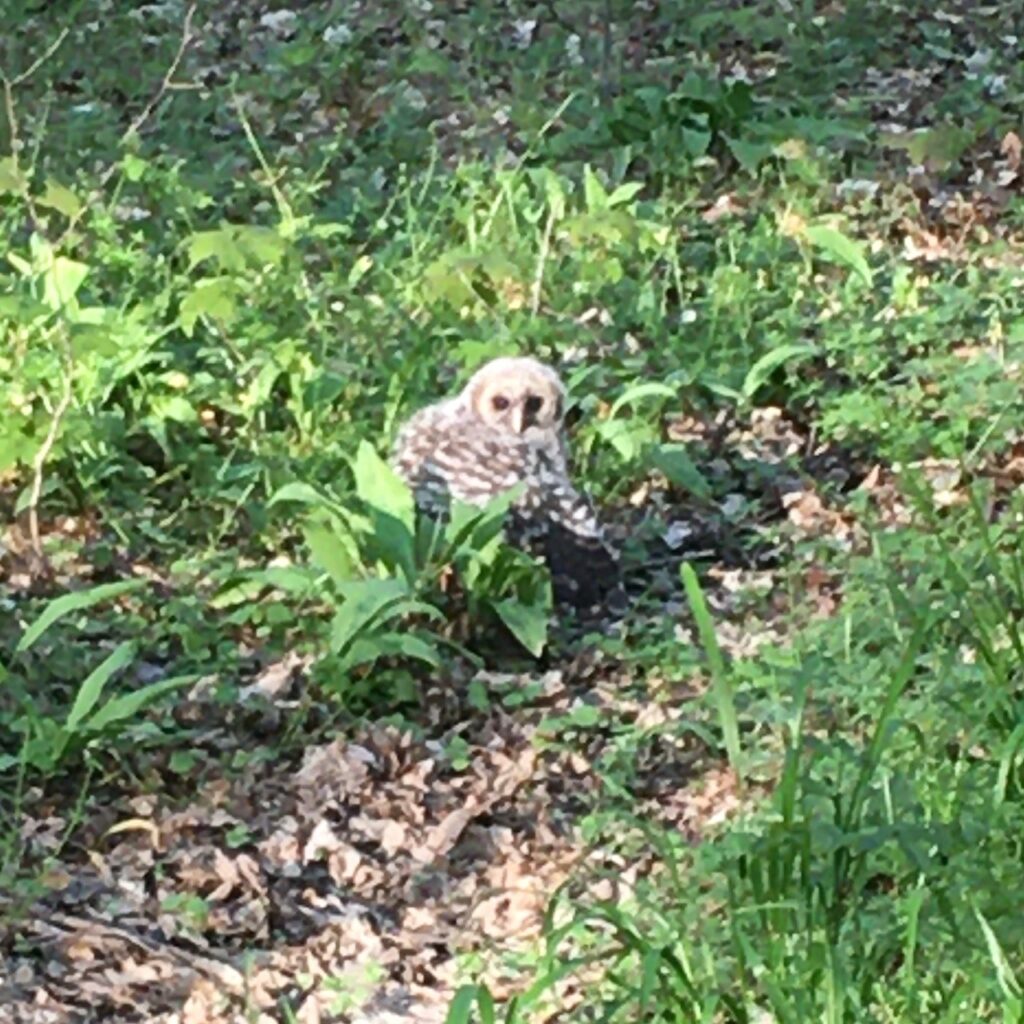
Sharing a few photos of wildlife in West Woods that my husband and I spotted on our run last night. This owlet was right by the trail and its parents were nearby higher up in the trees keeping a watchful eye. We didn't stay long but I did manage to get a few photos. Any chance you can tell what kind of owl this is?
Naturalist's Response
Thanks for the great photos!
You were lucky enough to spot a pair of Barred Owls.
In general, Barred Owls are a little more active in the day than other owls.
They have a distinct call of, “Who, who, who cooks for you? Who cooks for you all?”
We have a squirrel living in our backyard that is turning from brown fur to gray/white fur. This has been happening for about a month. Started on the head. Is this normal, or does the squirrel have some kind of disease?
Naturalist's Response
An Eastern Gray Squirrel (ODNR)
For our two common backyard squirrels (the gray squirrel and the fox squirrel), it’s normal for growing squirrels to undergo a “spring molt.”
Since you mentioned that your squirrel is growing in to gray/white fur, our best guess is that it’s a juvenile gray squirrel growing into its adult colors.
Another possibility is that you’ve spotted a squirrel with the inherited piebald color pattern. (You can find some great photos of piebald-colored fox squirrels in Texas here.)
Keep an eye on your local squirrel, and feel free to send us a photo if you can!
(Of course, if you really want to get into the details of the coloration of gray squirrels, you can always join in the Squirrel Mapper citizen science project. It’s actually a lot of fun!)
Do any of these parks have Virginia Bluebells coming into bloom soon. We only have one area in Leroy Twp in Lake County that I know of and would like to see some other growth areas.
Naturalist's Response
Definitely try the Beechwoods Trail at Big Creek Park! They should be blooming anytime now; it’s just dependent on the weather.
We have a problem with woodpeckers. A big one. They are making holes around our front door. How do we stop this and prevent it from reoccurring?
Naturalist's Response
Here are two links with suggestions for woodpecker problems. Wood siding does seem to attract insects (I get carpenter bees in my log home) and sometimes woodpeckers.
Hello,
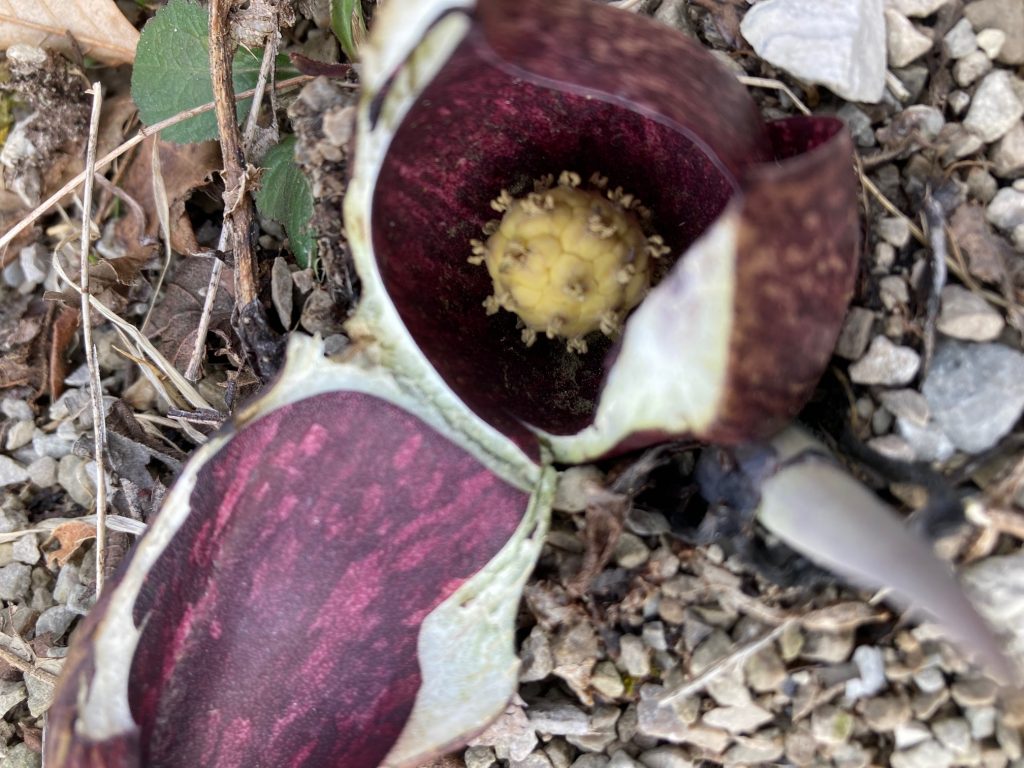
We encountered these skunk cabbage poking through the gravel trail at Lucia Nash. To our surprise, we noticed the blossoms within. What function do they serve, if any? Propagation? Anything else?
I've normally enjoyed skunk cabbage from a distance, usually tightly wound or unfurled. This was the first time I could look inside and see a blossom.
Thanks.
Naturalist's Response
Aren’t skunk cabbages awesome?!
(I’ll confess, they’re my favorite wildflowers.)
The “surprise inside” of skunk cabbages is the plant’s flower itself. It’s one of the earliest-blooming wildflowers in our area, and its trademark stinky odor is intended to attract carrion-feeding flies and gnats to help pollinate the plants.
By late summer, this fruiting body part of the skunk cabbage will drop a crop of seeds, which are then dispersed by water and wildlife.
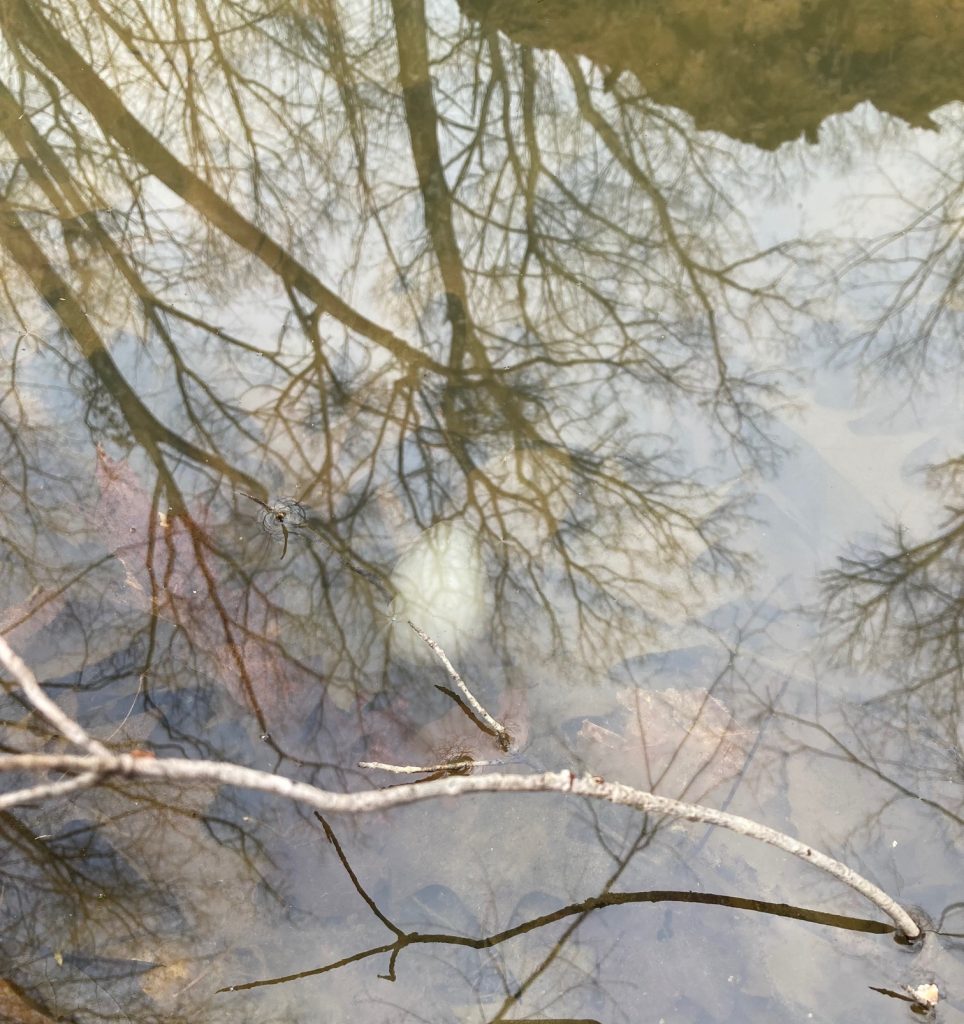
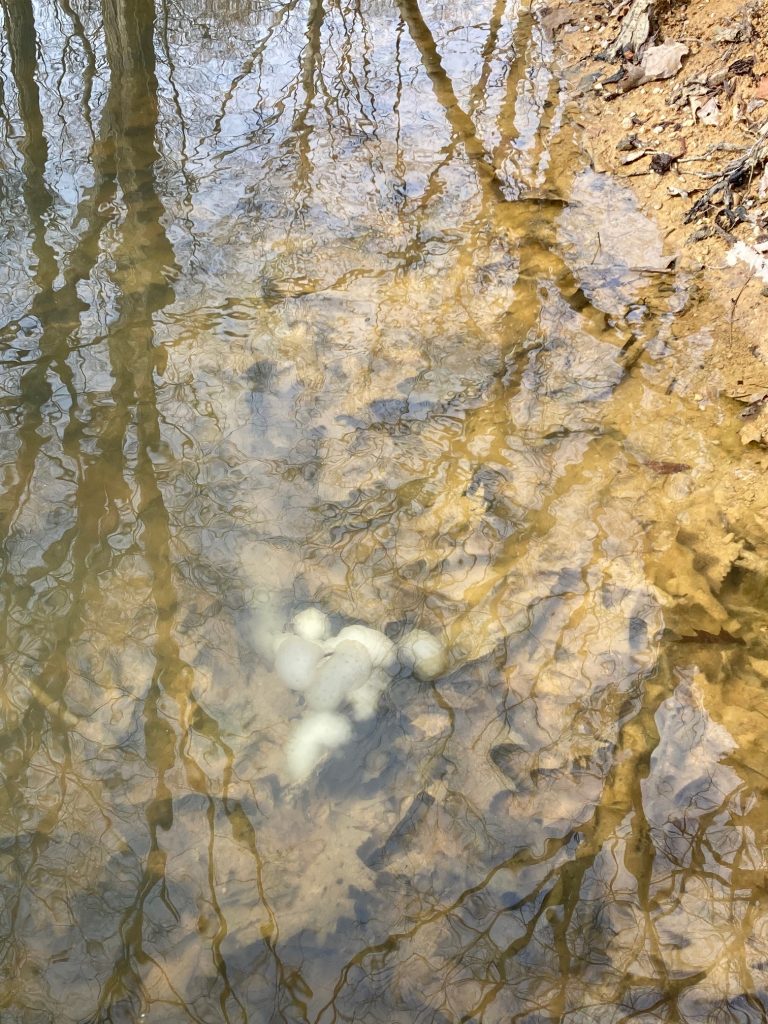
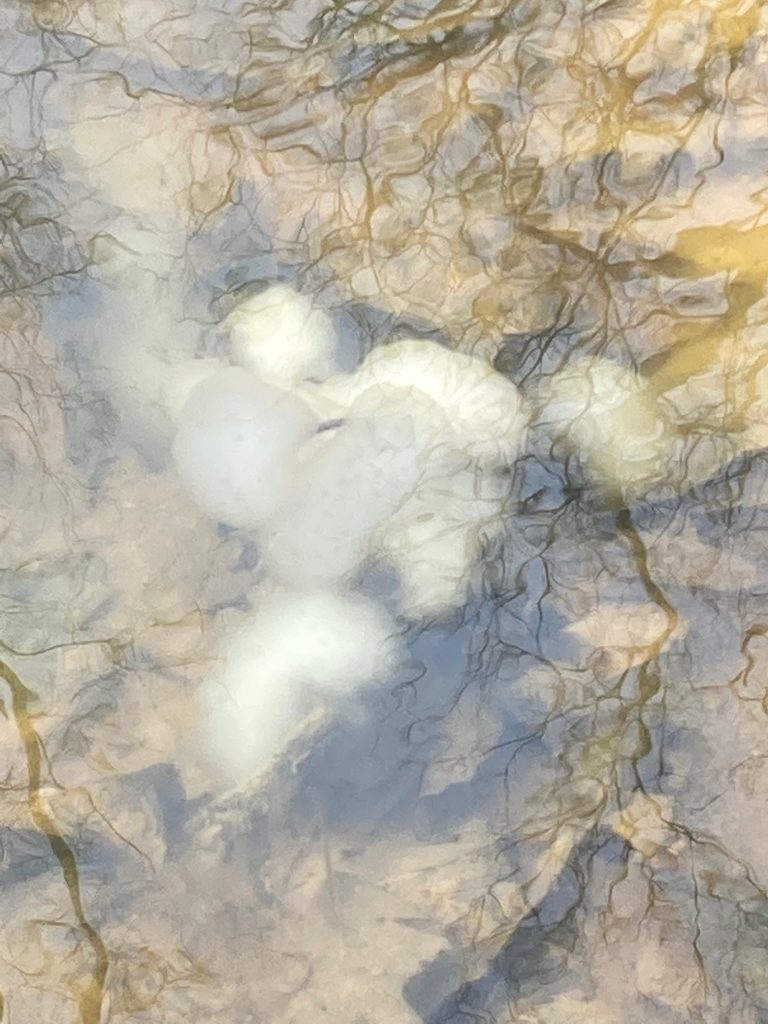
These white sacs were spotted in the water on yesterday's hike at the Lucia Nash nature preserve. Are they egg sacs? What creature laid them? A frog???
The water source is a big hole in the ground, where once a tree was rooted, and is now uprooted. The water filled up the root hole, and everywhere else, in that body of water, is quite clear.
We did not want to touch it for fear of disturbing it. It does not appear to be ice.
Any ideas? Thank you.
Naturalist's Response
They are indeed amphibian egg masses! I was there the other day and saw these exact ones. Some appeared to be salamander (Spotted or Jefferson), and some were wood frog. Thanks for your question. Good eye!
I heard there could be a chance at see the northern lights tonight (2/1/22). Would someone with any knowledge on this subject let me know if they have a minute? Thanks.
Naturalist's Response
A group of sun-watching satellites have detected a burst of activity on our sun this week. The Solar Dynamics Observatory satellite shows the sunspots associated with magnetic storms on the sun:
On January 30, the SOHO satellite caught this animated view of the Sun spewing out material from its outer layers. These “coronal mass ejections” send out the high-energy particles that can produce the Northern Lights effect on Earth.
All of this means that, yes, conditions are right for a low-level geomagnetic storm over the next two days — not enough to disrupt power grids, but possibly strong enough to generate the Northern Lights effect for parts of North America.
Both the NOAA and National Weather Service also offer a Space Weather Prediction service, which includes a forecast of the aurora (Northern Lights) activity that’s updated every 30 minutes.
Now, for the big question: will viewers in Geauga County, Ohio, get to see the Northern Lights?
The short answer is “possibly.” Conditions are right for an aurora that’s brighter and more-widespread than usual. However, this doesn’t guarantee that the Northern Lights will be visible to humans living in northern Ohio (around 41.5° north latitude).
Though rare, auroras are sometimes visible from here: as recently as 2003, Geauga County observers were able to see the Northern Lights with their unaided eyes.
(Photographers who take long-exposure photographs have been able to collect images of the Northern Lights many times since. However, cameras have a great advantage over unaided human eyeballs!)
Another complicating factor is the possibility of clouds blocking our view of anything in the sky over the next few days.
My feeders were busy before the storm (January 16, 2022) and they haven't been back yet (January 19). I have a heated bird bath that they never bathe in but do drink out of. Where do they go? It was pretty nice yesterday, why don't they come out? Are the feeders at The West Woods also abandoned at this time?
Naturalist's Response
Birds will increase winter feeding before a big storm to gain extra energy or to cache or hide food in case food sources get covered up. That being said, birds have several food sources in their territories that they can visit from day to day. It isn’t unusual for them to “disappear” for a few days after a snow storm like the one we just had. They most likely picked one or two areas to feed from to expend less energy while it is colder and the snow is deep. They should return soon.
The other reason birds abandon feeding areas is because the food can become wet and moldy in heavy precipitation, so you’ll want to make sure the food in your feeders is fresh. That way, when they do return, they will want to feed.
Can you suggest a reliable website to use to help determine the weather for trips to Observatory Park? It's a bit of a drive for us and we'd like to travel when there's a higher chance of visibility.
I appreciate your help!
Naturalist's Response
Ah, the eternal dilemma of stargazers: “Should I stay, or should I go?”
All of us would love to be able to predict future cloud conditions. Regrettably, there’s no certain method for foretelling out how cloudy the sky will be in advance of a visit to Observatory Park.
What’s more, it’s human nature to hope that we can “shop around” from different weather forecasts until we find one that tells us what we want to hear. (It’s an all-too-common sight to find two astronomers standing in the rain while one keeps insisting THEIR smartphone predicts clear skies.)
With that said, here are some of the best resources for checking on cloud conditions before a visit to Observatory Park:
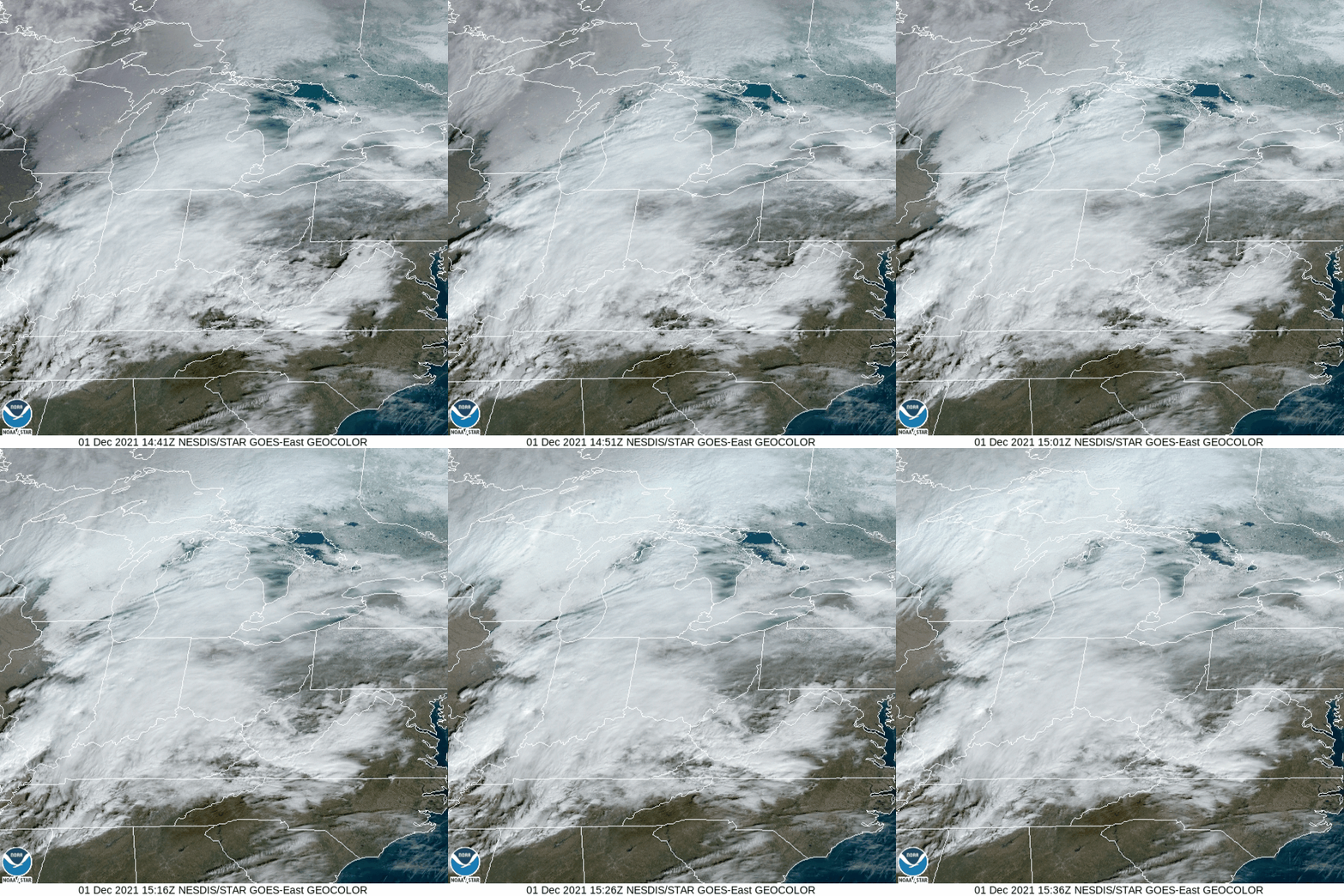
The National Weather Service’s Cleveland forecast office has a terrific webpage that displays a wealth of information on the current weather conditions in Northeast Ohio. It offers current weather radar (which tells more about precipitation than clouds), as well as the current satellite view (which is much better at showing clouds). You can also use their form to request a forecast for Montville, Ohio (zip code 44064) – the home of Observatory Park.
If you want to delve deeper into the satellite imagery, I recommend going straight to the source: the view from the GOES-East weather satellite includes a summary page for the Great Lakes region. (The truth is that whichever website you access to consume weather-satellite imagery for our area, it will just offer a re-hashed version of imagery from this satellite.) My favorite resource is to click on the “animation loop” image and see the past 12 hours of cloud conditions.
If you’re truly curious about current weather conditions at Observatory Park, you can also access our weather station. However, this is much more useful for reporting temperature, precipitation and wind conditions – it doesn’t measure cloud cover.
A popular forecasting site used in the astronomy community is the Clear Sky Chart service. Here’s the Clear Sky Chart forecast for Observatory Park. This forecast is based on a model developed by meteorologist Alan Rahill that relies on a sophisticated collection of weather data and tea leaves to predict future atmospheric conditions. (For locations in the famously-soggy Great Lakes region, its accuracy rivals that of the Magic 8-Ball.)
Of course, all the resources listed above are inferior to the most-reliable gauge of current cloud conditions: looking out a window. If you live anywhere within an hour’s drive of Observatory Park, you are likely experiencing the same cloud conditions as Observatory Park. (In general, if it’s cloudy in Mentor or Mayfield or Mantua, it will likely be cloudy in Montville, too.)
The unpredictable nature of clouds is part of the reason why we typically schedule six night-sky viewing programs per month; it improves our odds of catching a night with good weather.
Thanks for your email, and here’s to good-weather luck in the future!
Do you enjoy special events, family activities, experiences in Nature, programs for seniors or or several/all of the above? Sign up for our emails tailored to your interests by selecting the proper categories below. We promise we won’t flood your inbox – just send you what we think you’ll like.

 (440) 286-9516