Please ensure Javascript is enabled for purposes of website accessibility

Ask a Naturalist

Understand the world around you We've got answers

Ever wondered who left that footprint? What kind of berries are those? Or why is that White-tailed Deer white all over? Look no further than your local naturalists, the people at your Geauga Park District whose job it is to help you understand the natural world around you.


Use the form below to submit your question – ideally with a photo (if available), description of sighting (including size) and location of sighting (somewhere in Northeast Ohio) – and you’ll receive an email when a naturalist responds.

Please note that while this form does collect your name and contact information, those items will not be posted with your question, only used in case we need to contact you for additional details.

What have other people been asking lately? Scroll below the form and enjoy some other naturalist Q&As on us!

Ask a Naturalist

Step 1 of 2 - Sighting Details

  • Drop files here or
    Accepted file types: jpg, png, gif, Max. file size: 2 MB, Max. files: 5.
    • How might salamanders access an apartment?

      Question

      Have you encountered anyone stating that they had salamanders in their apartment? This came to my attention recently. The only information I have is that a tenant claimed she found dead salamanders in her apartment. The apartment is tight and was recently remodeled, thus, no mice or such.

      Naturalist's Response

      The only explanation I could give for salamanders in an apartment might be that the tiny critters found a drain or some ground floor access from a moist area outdoors. Since salamanders must stay moist, these amphibians would quickly dry and die indoors. Another possibility is that they were brought in with house plants or soil that had been outdoors for a time.

      -Naturalist Dottie Drockton

    • Ladybugs or Asian Lady Beetles?

      Question

      It is Nov 7th and we are seeing a lot of red ladybugs. Are they actually ladybugs or perhaps the Asian ladybeetle?

      Naturalist's Response

      Thanks for inquiring about ladybeetles.  You are correct that the beetles you are seeing are in fact the Multi-colored Asian Lady Beetle.  This beetle was brought to the US to be a biologic control for soybean aphids and scale insects.  It has since become established, often to the detriment of our native species.  It is highly variable in appearance. It may be red, orange or yellow and have many spots or no spots at all. In the fall, these beetles start looking for places to overwinter and will search out sheltered areas like the attic or inside the walls of houses, out-buildings, woodpiles, etc.  You can find some more great information on them at this link.

      -Naturalist Linda Gilbert

    • Should I destroy a Baldfaced Hornet nest?

      Question

      Should I or should I not destroy a bald face hornet nest? I can mow around it but it is very low in my tree (5' off ground). I have learned that they kill honeybees and yet they eat live bugs like deer flies. We have about 5 deer that routinely visit my yard. I killed their nest last year and felt bad about it. I cannot seem to find an independent opinion. I appreciate your taking the time to respond.

      Naturalist's Response

      Baldfaced hornets are beneficial because they reduce the numbers of flies and other insects (including even other yellowjackets) by using the live insects as protein to feed developing baldfaced hornet larvae inside their paper nest. Adult hornets are also beneficial native pollinators.

      During the warmer months, avoiding the area around a nest that is near the ground or buildings is the best course of action because the hornets will aggressively defend them. A hard freeze should kill any insects still in the football-shaped paper nests that become visible once the leaves are gone from the trees. Overwintering queens survive by finding a protected place under bark or in buildings. The queen will emerge in spring to lay eggs and begin a new nest with workers that enlarge the home of the new colony.

      Thanks for your question!

      -Naturalist Dottie Drockton

    • A report of less wildlife in our yard

      Question

      I live in NE Geauga Co (4 miles east of hambden). We normally have 4 species of squirrel and many wild birds in our yard. Normally this is time squirrels are very active hiding nuts. And we'd be filling bird feeders multiple times during week. In the past couple weeks I’ve seen NO squirrels and very few birds. What might be causing this change? I miss my wildlife!

      Naturalist's Response

      Sorry to hear about your diminished wildlife sightings!

      We haven’t seen any sudden decrease in the countywide population of birds or squirrels;  it seems like whatever’s spooked the wildlife in your yard is very localized.

      It’s hard to state a definitive cause over the internet, but one “prime suspect” is the possibility that a new predator has moved in.

      Sometimes when a hawk or owl moves into someone’s yard, there will be a sudden decrease in visits by small birds and mammals.

      (Terrestrial predators, like a new den of foxes, raccoons or coyotes, might scare off squirrels, but they usually have no effect on birds.)

      A second possibility could be that a nearby neighbor has increased their wildlife feeding; if that’s the case, all your “customers” might be over at the new buffet!

      If you’ve been providing bird seed and a source of water, it’s likely that wildlife will start returning to your feeders as we head into the “lean times” of autumn and winter.

      Keep an eye out for hawks and owls, and let us know what you find!

      -Naturalist Chris Mentrek

    • A report of less wildlife near Beartown Lakes

      Question

      We live near Beartown Reservation and have noticed a decline in wildlife sightings here including lack of deer, raccoons and birds. Has anyone else commented about this?

      Naturalist's Response

      Thanks for your inquiry of the wildlife at Beartown Lakes Reservation. No, we have not had other inquiries regarding wildlife populations in your area, but here are some thoughts on the topic that I can share.

      In the fall we can expect the local bird population to decrease due to some types of birds migrating south for the winter. Even our year-round residents may appear in fewer numbers as they move around their territories to forage for food and are singing less during non-mating season. Deer are in mating season and are looking for mates, so this may take them out off their summer territories as well.

      -Naturalist Renell Roebuck

    • Who laid this big egg in our woods?

      Question

      I found this (empty, cracked open, dry) egg in our woods yesterday. Any idea whose it is? Baseball for size reference. Thanks!

      Naturalist's Response

      Based on the size and location where you found the egg, I would say that this is more than likely a Wild Turkey egg.

      Thankfully they are quite common in the state, so keep your eyes and ears open for them throughout the year!

      Thanks for the great question.

      -Chief Naturalist John Kolar

    • What is so much cleared along the trails?

      Question

      Hello! While hiking at Sunnybrook Preserve today (Saturday, July 10) I noticed that a wide swath has been cut on both sides of each of the trails -- 4 to 6 feet, I would guess, and sometimes wider. I'm wondering why the Parks did this, there must be a reason and I am curious to know what the reason is! And thank you for removing the downed trees that had fallen across the trails entrance.

      Naturalist's Response

      Thanks for your question! I’m told by our operations and natural resource management staff that we usually cut (brush hog) a pass on each side to keep woody material from taking over and encroaching onto the trail. This also helps maintain proper drainage along the trail. Typically we try to do so annually along most of the trails if they are not in turf and mowed regularly. We have also done a lot of restoration work around the stream there over the past year, so perhaps you encountered some of the disturbance there during your visit.

      -Sandy Ward, Marketing

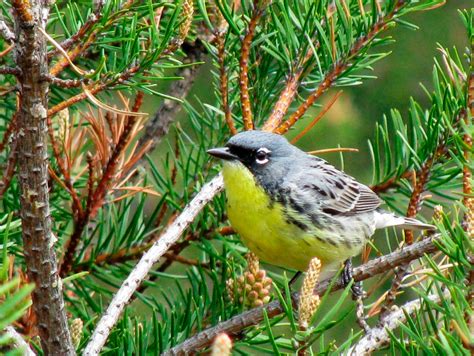
    • Do Kirtland’s Warblers live here?

      Question

      Do kirtland's warblers live in Ohio? I have heard that they live in Michigan. I also know that they are expanding their range.

      Naturalist's Response

      Kirtland’s Warblers live in areas where young Jack Pine forests are maintained by prescribed burning. There is currently a population in Mio, Michigan. I have not yet heard of any breeding in Ohio, but on occasion we will get to see them during their migration as they travel to and from the Bahamas. In fact we had one cause quite a stir when it landed at Headwaters Park in May of 2020!

      -Naturalist Renell Roebuck

    • What’s attacking the beech trees?

      Question

      We were walking the trail in West Woods and noticed the beech trees look infested. Looked like a good portion of the leaves were wilted. What is attacking them?

      Naturalist's Response

      What you are seeing is beech leaf disease.

      It was first discovered affecting American beech trees in Lake County in 2012. According to the Ohio Department of Natural Resources, it is now found in at least a dozen counties in northeast Ohio as well as Pennsylvania, New York, Connecticut, Massachusetts and Ontario, Canada. It effects American beech, European beech and oriental beech.

      This disease causes significant die-off of trees. Young seedling and sapling trees in the understory are the first the be affected. These young trees usually will die within two to five years. Larger trees when infected will live a little longer, but they, too, will die from this disease.

      There seems to be a connection between a microscopic size nematode, which is a round worm, and beech leaf disease. Research on the cause and management is ongoing by many different organizations throughout the US and Canada.

      Sadly right now there is no know effective method to prevent or treat this plant disease.

      Thank you for your question.

      -Naturalist Denise Wolfe

    • When do the swifts come to Berkshire High?

      Question

      when do the chimney swifts come to burton high school

      Naturalist's Response

      Thanks for asking about the “bird tornado” – that is, the roosting behavior of Chimney Swifts. These birds find staging areas that they use for a roost as they begin their migratory journey to South America.

      The swifts that use the Berkshire High School chimney during their journey can be seen at the end of summer, usually the last week of August and into September. They usually start circling the chimney just a little before dusk around 8 p.m. By the end of September, their numbers dwindle as the majority have headed south. You can find more information about chimney swifts at this link.

      -Naturalist Linda Gilbert