Ever wondered who left that footprint? What kind of berries are those? Or why is that White-tailed Deer white all over? Look no further than your local naturalists, the people at your Geauga Park District whose job it is to help you understand the natural world around you.
Use the form below to submit your question – ideally with a photo (if available), description of sighting (including size) and location of sighting (somewhere in Northeast Ohio) – and you’ll receive an email when a naturalist responds.
Please note that while this form does collect your name and contact information, those items will not be posted with your question, only used in case we need to contact you for additional details.
What have other people been asking lately? Scroll below the form and enjoy some other naturalist Q&As on us!
I was at my property near LaDue having a bonfire and we heard a strange sound that almost sounded like a cat mixed with a person yelling. I am used to the sounds of owls, coyotes, sandhills, etc., but the last time I heard a sound similar to the one I heard it was two bobcats when I was in western North Carolina.
Do we have bobcats here and is there another possibly culprit?
Naturalist's Response
Thanks for your question!
Bobcats are rare in Northeast Ohio, but they are around. The Ohio Division of Wildlife has recorded three confirmed bobcats in Geauga County between 1970 and 2020.
Have a listen to this recording of various bobcat sounds and see if it is a good match for what you heard. (Personally, I’ve always thought that bobcats sound like a human trying to imitate a crow!)
My other suspect for the sound you described is a “fox squawk”:
Keep your ears open, and let us know what you find!
Can I start filling my bird feeders now? Is bird flu still an issue? My friends with chickens don't let their chickens out so they don't have contact with the wild birds. Is there extra hygiene of the feeders I need to do? Thank you.
Naturalist's Response
Thanks for your question!
The newest strain of avian influenza (“Highly-Pathogenic Avian Influenza,” or HPAI if you want to sound like the cool kids) seems to primarily affect waterfowl and domestic poultry; songbirds seem to be at low risk.
Here at The West Woods Nature Center, we clean our feeders monthly following these handy instructions. Thankfully we haven’t spotted any diseased songbirds locally, either, giving us all the more reason to look forward to observing the winter feeding season through our lobby’s gargantuan windows!
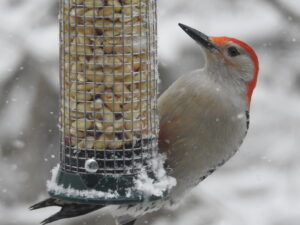
Red-bellied Woodpecker at The West Woods Nature Center’s Wildlife Feeding Station
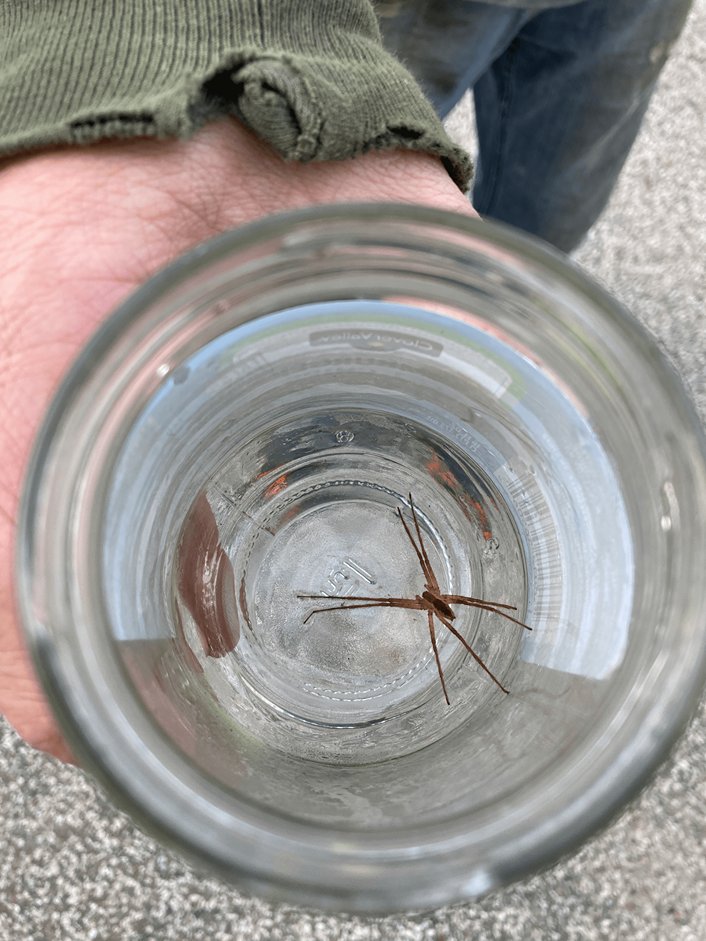
Hi, my family and have I found two of these big spiders on our house (this one on an outside wall, another in the garage). My mom is concerned it’s a brown recluse, but our research has been inconclusive. Any chance you guys can help? Much love!
Naturalist's Response
Hello! Thank you so much for your inquiry. I tried to zoom in on the photo, and from what I can see, I would say it is a Nursery Web Spider (Pisaurina mira). This is a pretty common spider sometimes found on or near houses, but not considered dangerous.
Many people have similar concerns as your mother did, that it is a spider that can be medically significant and cause concerns of safety, like the Brown Recluse. However, living in Northeast Ohio we don’t have any resident populations of spiders that pose a threat to humans.
We live near Auburn Marsh and every spring as soon as the weather gets warmer we hear a chorus of frogs going on almost through the entire night. This keeps going on the entire summer - very noisy and pleasant at the same time. Except this year, 2022. Nothing, no sound of frogs. It's already June and no noise. What happened?
Naturalist's Response
That is very unusual that you would not be hearing any frogs this summer. Typically, we hear an explosion of frog activity in wet areas in late March or April as spring peepers and wood frogs enter the breeding pools. Peepers make a distinctive ‘peep peep’ sound and can sound like jingle bells when in full chorus. Our wood frogs make a unique ‘clack clack’ sound. After wood frogs are finished, we will hear toads, with their high-pitched trill, followed by tree frogs. As the summer progresses, those loud choruses will be replaced with bull frog or green frog calls. Bull frogs sound like light sabers, and green frogs sound like a banjo being plucked. Is it possible you missed the springtime chorus this year, or have you truly not heard any frogs? The only possibility I can imagine, if there are no frogs near your home, is that something killed them all — like a pollutant or pathogen. Listen early next spring at night and hopefully you will hear them again!
I have noticed that tulip trees are quickly taking over some of the former fairways at Veterans Legacy Woods. Previously the primary tree species was maple trees which surround those areas. I have looked around and found zero maple seedings/saplings filling in the once open areas. I know that tulips are very fast growing...but will the new wooded areas continue to be all tulip trees?
Naturalist's Response
Tulip trees are a fast-growing pioneer species, which means they are one of the first trees species used to start turning field back to forest. Other pioneer species are aspens, eastern cottonwood and sassafras. Different species of maples usually start growing once a young forest is in place, then as the pioneer species die, the maple trees start taking over. Once the maple trees dominate, the forest becomes what is known as a climax forest. Then maples will persist until there is a major disturbance, like clear-cutting.
But there is another, sadder, side to this story. Earthworms are not native to Ohio, and they exert a strong negative influence on maple trees, especially seedlings. Areas of high earthworm density have very few young maple trees. Golf courses would certainly be an area of high earthworm densities, so there will be even fewer new maples trees than expected. This may change what trees will dominate our forests as we go into the future.
Any idea what these insects are??
All over the swamp weeds seed pods!!
Are they invasive??
Naturalist's Response
What a great patch of swamp milkweed! The insects on your plants are large milkweed bugs at various stages of development. Since they are true bugs, they use their piercing, sucking mouthparts to feed on the seeds of your milkweed.
Despite the large number on your plants, the insects are native and not considered invasive. The large milkweed bugs are not a threat to Monarchs or other insects, either. Still, if you’re concerned about the numbers and impact on your patch of milkweed, the bugs can be manually removed and dropped into soapy water. Here’s a link with more information and pictures of some of the other insects found on milkweed plants:
We attended the Moths and Meteors event on 08/12, and were so impressed with Chris. What kind of education and/or training is required to become a naturalist?
Naturalist's Response
Thanks for your question!
Naturalists come from a staggering variety of educational and training backgrounds. Some have pursued an education in science and teaching fields, but many come to the field from other careers — in many cases, their work in sharing Nature knowledge with the public begins on a volunteer-and-hobbyist basis.
Take the example of Wayne Kriynovich, one of our now-retired naturalists:
[Naturalist Wayne Kriynovich performs daytime maintenance on the Oberle Observatory.]
Before becoming a naturalist, Wayne had been a police officer, a lawyer and a private pilot. More importantly, he was a lifelong astronomy enthusiast! Wayne’s dedication to sharing astronomy with the public led him to become an astronomy-focused naturalist after retiring from (as he called it) his “Earthbound career.”
Once a person begins working or volunteering in the Nature-education field, they typically receive additional training from the National Association for Interpretation, or NAI. It’s sort of the professional organization for workers in parks and historic sites. Despite the word “interpretation” in the name, no, it doesn’t primarily deal with translating between different languages!
The NAI offers a widely sought program called Certified Interpretive Guide training, which is a terrific way to learn how to share information with the “curious, but not expert” public. (If you’ve ever had a lackluster tour from a less-than-fascinating guide, you know what pitfalls there are to be avoided!)
Another great resource in the field of astronomy education is the Great Lakes Planetarium Association, which, as the name suggests, helps share training among planetarium users across the region. Similarly to naturalists, planetarium operators may have specifically studied planetarium-based astronomy (Youngstown State University offers one such program nearby), but many also come by their experience through on-the-job training.
The snake you have pictured is a Northern Water Snake (Nerodia sipedon). This is one of the most common species of snakes we find in Geauga County and is an important part of our local ecosystem. They feed on fish, frogs and salamanders, but in turn provide food for herons, mink, hawks and other predators.
The good news is they are not venomous and are inclined to flee from humans. However, if they are grabbed, they do not hesitate to bite, though the wound is pretty superficial.
Do you know what kind of snake lives in the stairs of the sledding hill at Beartown? It’s large and dark grey.
Naturalist's Response
There are a number of snakes that can be described as large and gray in our area. At Beartown Lakes, the most likely species would be a Northern Water Snake, but the Black (Gray) Rat Snake is also a strong possibility. Lastly, some Eastern Garter Snakes can have reduced pattern and would fit that description. All three of those species are very common in our area and likely to live in the base of stairs.
Do you know of a resource for getting wild rice stalks? My 5th grade class is reading The Birchbark House series by Louise Erdrich in which a native family gathers wild rice in Michigan. I'd like to be able to show the students the wild rice, use it to study parts of a plant, learn about adaptations of plants living in water and maybe even explore how to separate the grains from the plant. Any advice is appreciated! Thank you so much.
Naturalist's Response
I’m not familiar with a source for the plant, but I did a Google search and found this site which might be what you’re looking for:
There appear to be a lot of options to purchase seeds, though. You may also try the Museum of Natural History, as this state-listed species has been found at Mentor Marsh.
Finally, if you are looking for an alternative plant to help your kids practice winnowing the grain, I would recommend wheat (straw) plants, which are plentiful this time of year.
Do you enjoy special events, family activities, experiences in Nature, programs for seniors or or several/all of the above? Sign up for our emails tailored to your interests by selecting the proper categories below. We promise we won’t flood your inbox – just send you what we think you’ll like.

 (440) 286-9516