Ever wondered who left that footprint? What kind of berries are those? Or why is that White-tailed Deer white all over? Look no further than your local naturalists, the people at your Geauga Park District whose job it is to help you understand the natural world around you.
Use the form below to submit your question – ideally with a photo (if available), description of sighting (including size) and location of sighting (somewhere in Northeast Ohio) – and you’ll receive an email when a naturalist responds.
Please note that while this form does collect your name and contact information, those items will not be posted with your question, only used in case we need to contact you for additional details.
What have other people been asking lately? Scroll below the form and enjoy some other naturalist Q&As on us!
Does Geauga County have Hybrid Coyote or Wolf/Coyote cross? I have seen (twice) a medium sized dark colored Canine running across the road in the SAME exact area at two different times towards dusk.
Naturalist's Response
The canine you have seen is most likely a dog, or possibly a coyote, since wolves do not live in Ohio. Coyotes gradually moved into our state, and all of North America, from the southwestern plains, as wolves were eliminated from Ohio in the middle of the 1800s and most of the lower 48 states by 1900.
Research and genetic analysis of the Eastern Coyote seems to conclude that the canine now found in all 88 Ohio counties is slightly larger than the southwestern coyote and likely has a small amount of DNA of both wolf and dog. Coyote expert Stan Gehrt, a professor of wildlife ecology at Ohio State University, rejects the term “coywolf.” He doesn’t even like referring to them as hybrids, which implies a 50-50 mix of wolf and coyote, and just isn’t the case.
If you see the canine again, you will know it is a coyote if it has a drooping bushy tail, pointed ears, a slender muzzle and long legs, but a dog if the tail curls upward. Coyotes are variable in color, so a dark-colored canine could still be a coyote, especially if the rest of the description seems to fit.
4.0 CULTURAL AND NATURAL FEATURES, COLLECTING
4.1 No person shall destroy, disturb, deface or remove any natural, archaeological or cultural feature from any area within the Park.
4.2 No person shall collect any animal including birds, invertebrates (including mollusks), non-game fish, amphibians and reptiles or plant material in any area of the Park without written permission of the Executive Director, except leaves that have dropped from trees may be collected for educational purposes and game fish may be taken as designated in Section 12 “Hunting, Trapping and Fishing.”
To request permission through our permitting process, click here and scroll down to Special Uses.
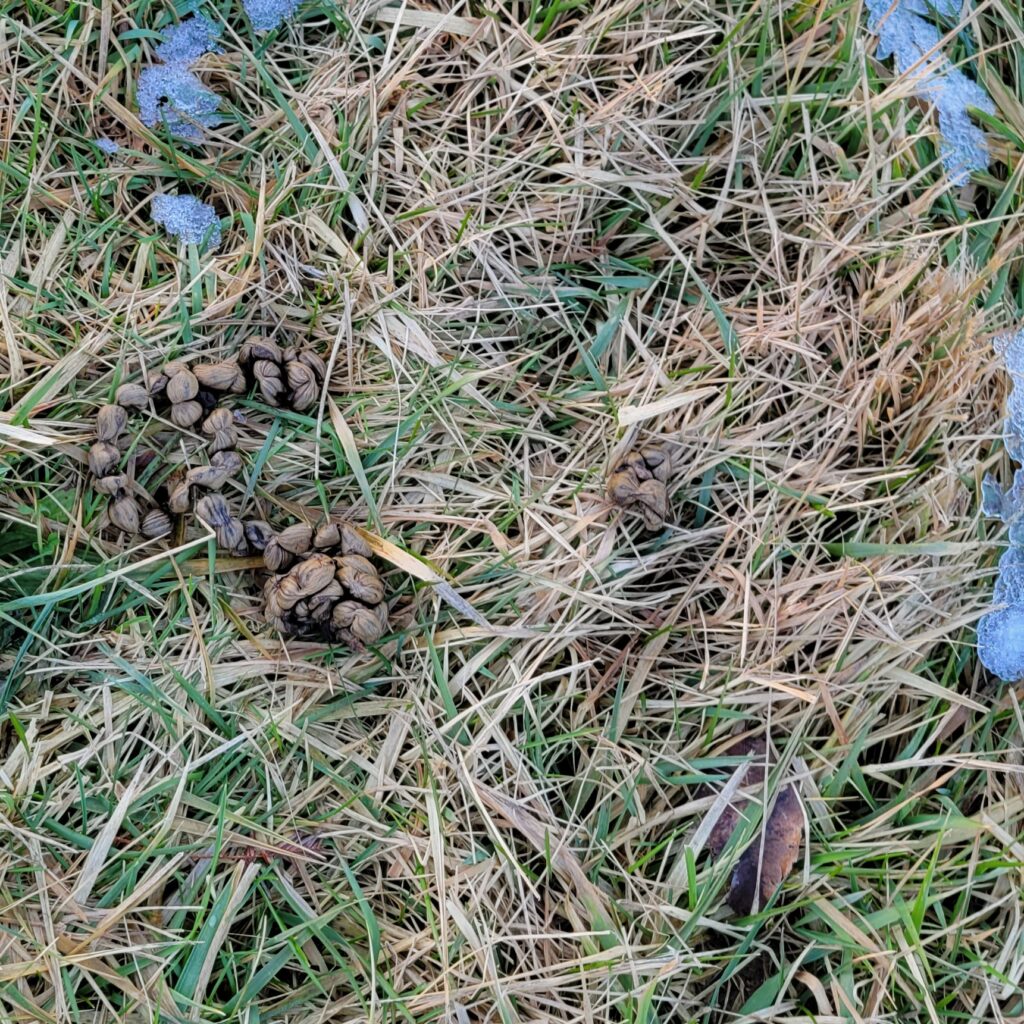
Hi! Can you help me identify this? I found it a few days ago in my backyard field, and assume it's scat, though I can't find anything like it online. (I might have seen this in my yard about 4 years ago.)
I live in Madison, OH, on 5 acres in an area of fields and dense woods. A tributary creek from Arcola Creek runs across the back. We see a good variety of Ohio wildlife.
The pile is easily the size of an open hand. If you zoom in, you can see another piece to the right.
Naturalist's Response
This was a tricky one!
We pride ourselves on knowing our scat, but your animal-droppings question almost had us stumped.
The consensus from naturalists Andy “Number One at Number Two” Avram and John “Dr. Scat” Kolar is that this is probably deer scat, just in an uncommon form.
Typically, when deer have been browsing on leaves and twigs, their scat takes the form of discrete “pellets.” (The parallels to Raisinets candy are rather precise.)
However, when deer have been eating more grasses, weeds and forbs, their scat can take on a stringier shape, with each bolus connected by fibers to its neighbors in an (ahem) necklace-like configuration. (We think that’s what’s in your photo.)
Naturalist Karie “The Droppings Whisperer” Wheaton notes that this type of scat also gives you an X-ray-like image of the deer’s intestines.
When they’re freshly deposited, even pellet-like scat can still sometimes retain this shape, like a mass of garlic-clove-shaped boluses joined end-to-end, as you can see in this stock photo:
That might have been more information about scat than you wanted, but it’s a fascinating opportunity to learn about Nature. Thanks for sharing your observation!
– Geauga Park District’s Naturalist Team (written up by Naturalist Chris Mentrek)
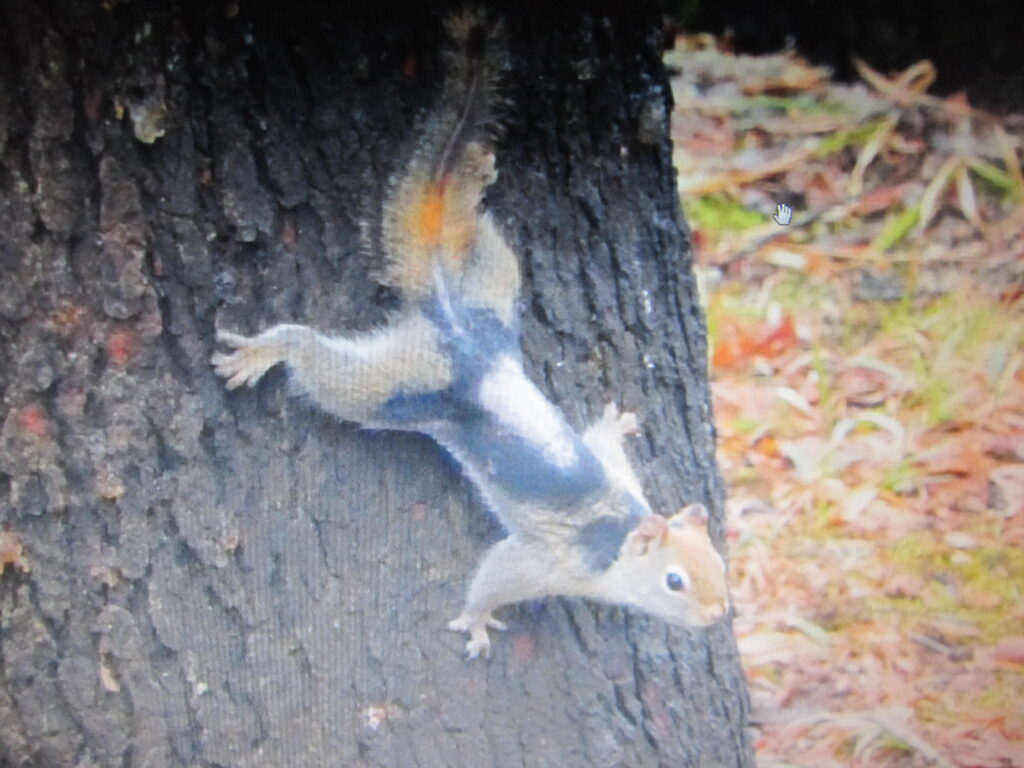
This guy showed up yesterday at my house: webbed middle tows, every color of a squirrel. What do you think it is? It does not appear to have mange, but the hair on its back is very thin, short and white. Someone I know thought you might be able to tell me.
Naturalist's Response
Thanks for your photo!
Your question really created some discussions among the naturalists.
It looks like the animal in your photo is a Red Squirrel, Tamiasciurus hudsonicus, with an unusual color variation.
Despite their name, Red Squirrels can have an astounding variety of colors in their fur: red, white, brown, and even gray.
Take a look at this snapshot of an unusually colored Red Squirrel spotted in Hambden Township by Naturalist Andy Avram:
Unusually-colored squirrel in Hambden
The color variations arise as perfectly natural genetic variations, and are sometimes passed on within particular squirrel families. As a result, different color variations can become more common in a particular location.
Every so often, a litter of squirrels is born with a “piebald” or varied color variation, and the squirrels become local celebrities. Last year, a piebald Easterm Gray Squirrel named “Pinto Bean” charmed the University Of Illinois campus.
Naturalists Dottie Drockton and Nora Sindelar point out that your squirrel seems to also show some fur loss, particularly in its tail. There are a huge variety of fungal infections, pests and other diseases that can cause fur loss, which is well explained in this summary from Purdue University.
It will be interesting to see whether or not there’s a larger population of these unusually colored squirrels in Northeast Ohio. Keep an eye out, and let us know if you spot any!
– Geauga Park District’s Naturalist Team (written up by Naturalist Chris Mentrek)
Hi, I've been seeing a lot less birds the past few weeks and expected to see them back today with the snow. Is there something going on with the birds - I usually have blue jays, cardinals, chickadees mostly but the only ones here this morning are the juncoes. The last bag of black-oiled sunflower seeds we bought look a little brownish, could they be bad? They came from Centerra in Munson and I wondered if anyone else has said anything about them. Please let me know if you have any ideas. If there is no bird disease going around, I'll try replacing the seeds. Thanks for your help.
Naturalist's Response
I don’t know why birds disappear from people’s feeders sometimes. Maybe something in the surrounding habitat has changed, or because the weather has been mild these past couple winters, the birds are finding their own food; maybe the seed could be bad; or maybe a combination of some or all of the above.
-Naturalist Linda Gilbert
Why do birds
Suddenly disappear
Even if
Seeds are here
Just like me
They long to feed
Somewhere new
But seriously, I am on board with what Linda said.
Today we saw a deer eating english ivy in our yard. Not sure if it was male or female. Question: It had both ears tagged. Does the park district tag the ears of a deer & why? Thanks.
Naturalist's Response
Sorry for not having an answer in this case, but no, the Park District does not tag deer. I know there are deer farms in Middlefield that raise deer; maybe one of theirs escaped.
On Jan. 19, I was a short way along the Overlook Trail at Welton's Gorge and noticed some cut branches (vines?) that had a very bright blue sap-like substance coming out of the cut ends. The blue certainly doesn’t look natural color-wise, so I wouldn't be surprised if it is some sort of treatment. Thanks for any information you can share!
Naturalist's Response
Occasionally, Natural Resource Management controls grapevines that pose a threat to some of the park’s more mature and valuable wildlife trees (like oaks). Normally, we do not control these grapevines because they are valuable in their own ways; they provide nesting material for many songbirds, and of course food and habitat for wildlife. Once in a while, though, there are situations when they begin to damage our highly important mature trees. After discussion with me, the land stewards decided to remove some of them in this case . The vines are first cut, then carefully treated by our licensed pesticide applicators (land stewards) with an approved herbicide. The blue you see is simply a dye that helps them keep track of which vines have been treated.
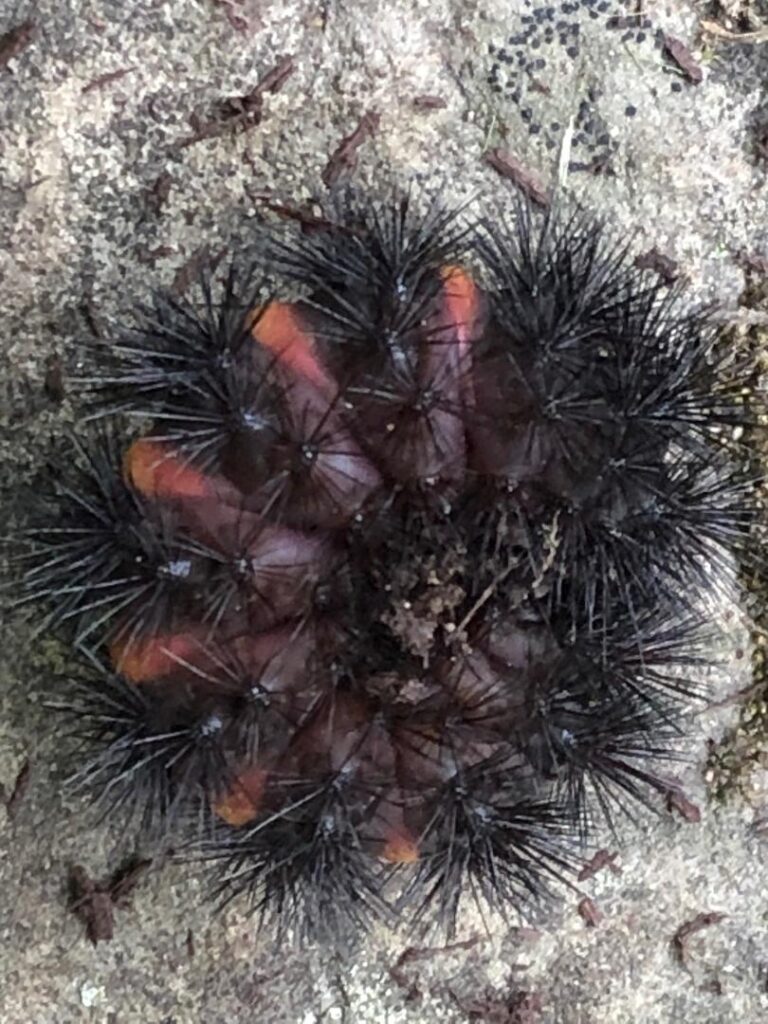
Found this on our property in Hambden Twp. in May. Came back to see it again in about 5 minutes and it was gone. Any idea on what it may be? Thank you!
Naturalist's Response
Thanks for sending a nice picture of a Giant Leopard Moth caterpillar.
Giant Leopard Moths belong to the tiger moth family. If you haven’t seen what the moth looks like, check out this link at bugguide.net.
Look for the adult next spring/summer — they are attracted to lights.
I was unfortunately unable to attend the "Plant Your Own Meadow" event because it was filled when I went to sign up. Was the event recorded? If so, could I please view it? If not, could you please share any information? Thanks so much for your help!
Naturalist's Response
Although I am not able to share the Park District’s presentation, here are a few sources that should be helpful.
A recording of Shana Byrd’s webinar (week #5) is available here. And our presentation also used Doug Tallamy as a resource. Find his website here: TALLAMY’S HUB — HOMEGROWN NATIONAL PARK.
You can also watch for more Park District programs on native habitats in 2023. Thanks for your interest!
Do you enjoy special events, family activities, experiences in Nature, programs for seniors or or several/all of the above? Sign up for our emails tailored to your interests by selecting the proper categories below. We promise we won’t flood your inbox – just send you what we think you’ll like.

 (440) 286-9516