Ever wondered who left that footprint? What kind of berries are those? Or why is that White-tailed Deer white all over? Look no further than your local naturalists, the people at your Geauga Park District whose job it is to help you understand the natural world around you.
Use the form below to submit your question – ideally with a photo (if available), description of sighting (including size) and location of sighting (somewhere in Northeast Ohio) – and you’ll receive an email when a naturalist responds.
Please note that while this form does collect your name and contact information, those items will not be posted with your question, only used in case we need to contact you for additional details.
What have other people been asking lately? Scroll below the form and enjoy some other naturalist Q&As on us!
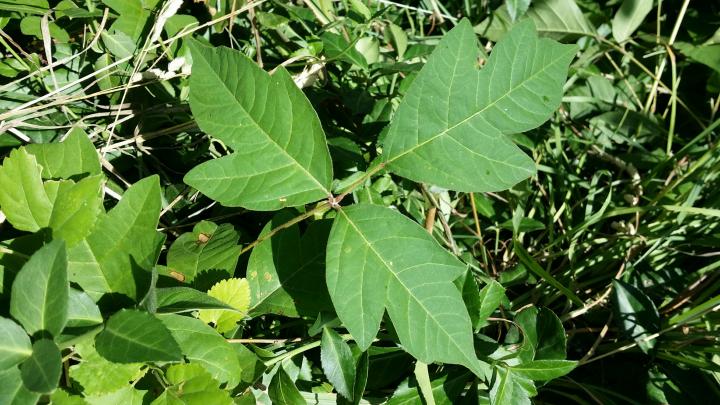
A large willow tree in our yard was damaged by a wind/snow storm and was taken down. We stopped removal when we found large areas of poison ivy. What is the best nontoxic removal of poison ivy on a large area?
Naturalist's Response
Oooh, this is a tricky one:
It’s very difficult to eradicate a thriving growth of poison ivy, and it’s even harder to do so without feeling the plant’s itchy effects!
Protecting Yourself From Itching:
You will have to wear gloves and thoroughly wash up, as well as thoroughly wash any tools and clothing that you wore while working with the poison ivy in your yard. The oil from the plant, which is what causes the rash, can be spread from the tools onto your skin, and can remain on the tools until it is washed off.
There are specific products that you can use to wash yourself both before and after to help prevent the rash, should you wish to research those online.
Removing The Plants:
Poison ivy, Toxicodendron radicans, is a hardy plant, but it can be killed with most systemic herbicides.
There are alternatives that offer less risk of harm to yourself and the environment, but which still kill plants:
Horticultural vinegar: Vinegar (acetic acid) works well as a plant-killing spray. Household vinegar is typically diluted to 5% acidity, but you can find ‘horticultural vinegar’ with a strength of 30% acidity at lots of hardware and garden stores. Adding some dish soap (about 1 ounce per gallon of vinegar) as a surfactant will boost its efficacy. There are also commercially-produced, vinegar-based weed killers with the soap already mixed in; again, check your neighborhood store.
Citric acid: Similarly to vinegar, citric acid is a food-safe ingredient that’s been incorporated into several commercially-produced weed killers. (It’s often combined with clove oil for an extra punch. Bonus: it makes your garden smell like a spice rack!) Try a web search for “citric acid weed killer” and you’ll see plenty of examples. I’ve found that more and more Ohio stores are carrying these products nowadays in an effort to carry a ‘more-natural’ inventory.
Boiling water: Some gardeners swear by using boiling water to kill poison ivy plants at the root. Just be sure to use all the safety measures you’d use in the kitchen; nobody wants to stand in a cloud of poison-ivy-infused steam!
Unfortunately, it usually takes a lot of work to conquer an established patch of poison ivy. Whether you pull, dig, cut or spray, it will likely take several rounds before you knock out your opponent. (That’s why we think poison ivy would make a great mascot for toughness and resilience!)
I need a naturalist's help. Last night after 10 PM, I heard a repeated sound that I believe was a night calling bird. I checked my bird book, but the sound did not meet the descriptions of any owls or nightjars. The call was almost the opposite of a screech owl. Although it was in the same range, it rose in pitch and had no trill. It repeated over and over for at least a half hour. I heard Barred owls in the background, but this sound was not nearly so deep.
Naturalist's Response
Apologies that we never got back to you about this question. If you hear it again, please try to take a recording with your phone and email it to info@geaugaparkdistrict.org with your question. We’d be happy to try to ID it with a recording!
What kind of swans are in the swamp at the corner of Auburn and Pekin roads in Newbury?
Naturalist's Response
The swans at “the Pekin Road swamp,” as we call it, are Mute Swans.
Mute Swans are not native. I believe they are from Europe.
These swans probably escaped from someone’s pond and have been at the Pekin Road swamp for at least a year.
Although Mute Swans are extremely beautiful birds, they pose problems and are unfortunately undesirable to have around because they are very aggressive, even to people. They also eat a tremendous amount of aquatic vegetation and therefore displace native species of waterfowl and damage the ecosystem.
I would like to know if the vertical windmill at Observatory Park is hooked to the electrical grid. If so, how much can that set up produce?
Naturalist's Response
Thanks for your question!
The wind turbine at Observatory Park is connected to the electrical grid, and can produce up to one kilowatt (1,000 watts) of power.
I say “up to” one kilowatt, because the turbine only reaches its maximum output when the wind exceeds 12 meters per second (over 26 miles per hour). However, our average wind speed at Observatory Park is less than 10 miles per hour:
On most days, the solar panels at Observatory Park out-generate the wind turbine!
The exact model installed at Observatory Park is a UGE-1K; the UGE company is now part of VisionAir.
Hello. We were hiking at The Rookery today and walked by a small body of water absolutely full of frogs. They sounded a lot like chickens clucking. What kind of frogs are they? Thanks.
Should I worry about coyote coming up to our deck? We live in the Lake in the Woods neighborhood. We hear them often and see them run by every once in awhile. This week we saw three of them walk through the woods quite close to our yard. Then, that night, we were woken up to them on and near our deck! I'm worried they may be building a den. It's a neighborhood full of children and pets. Is this the time of year they build dens? It seems odd that they're coming so close to our house? Our kids play in the woods, but if it sounds like they're making a den this would be unsafe. Thanks for any insight you may have!
Naturalist's Response
Thanks for your question about coyotes. Geauga County has perfect coyote habitat. These mammals are highly adaptable and are capable of living among humans, but prefer to shun people. Most of the time folks don’t even know they are around.
I’m not sure why they would come up on your deck. Hopefully there isn’t any pet food, etc. that might be attracting them. I wouldn’t worry unless they start appearing on/around your deck on a regular basis.
You’ll want to secure any places under your deck to exclude unwanted critters. Female coyotes choose a den site in late March and April, so it is too early for them to be making a den; also noteworthy, breeding time is the only time they use dens.
Coyotes do not live in packs, but rather in family groups that consist of the alpha male and female and any offspring, so you probably have a family group traveling through their territory. I made a picture with Lake-in-the-Woods at the center of a circle that shows the size of a coyote family group territory: approximately 2470 acres.
If you have further questions, feel free to give me a call at The West Woods Nature Center.
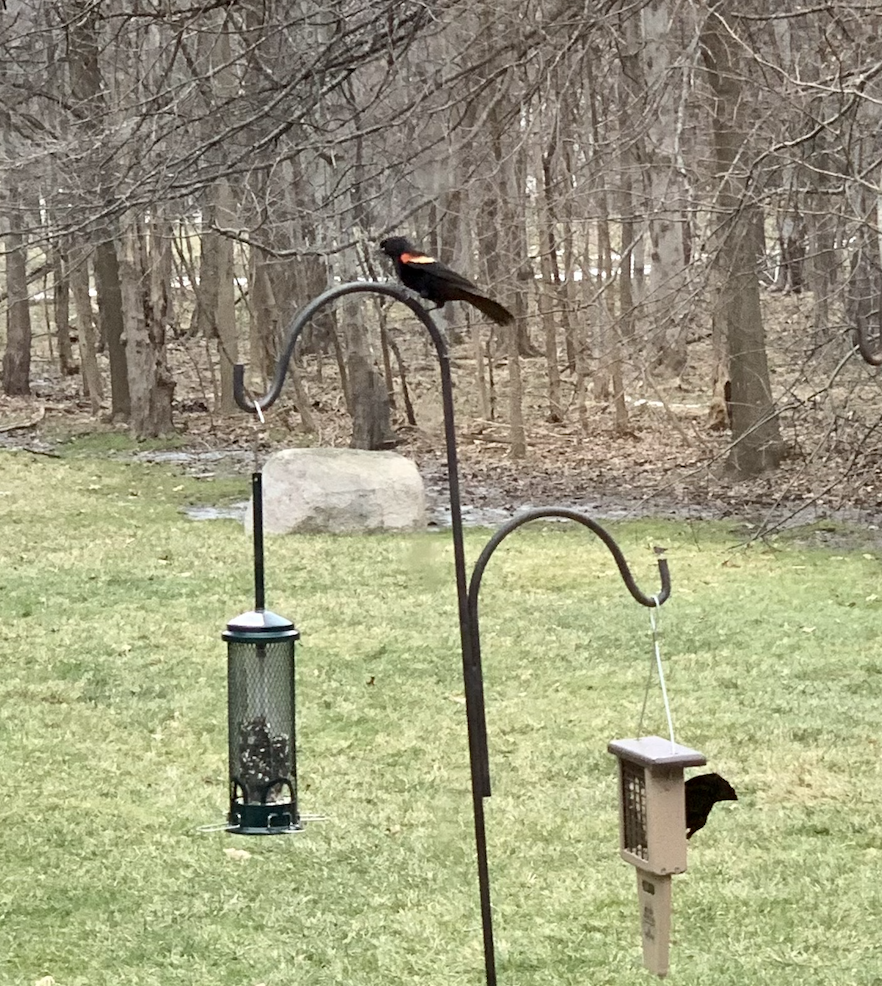
I spotted these Red-winged Blackbirds in my yard. I am surprised to see them in January - any explanation? Thanks!
Naturalist's Response
Nice find!
Although the majority of our local Red-winged Blackbirds do migrate to warmer areas in the winter, it is not unusual to see small numbers remain in Geauga County throughout the winter.
I have seen larger flocks, like the one you had in your yard some winters. But more often than not I see smaller groups and individual birds throughout the winter.
Often it depends on the weather; the harder the winter, the lower number of red-wings that we see.
In about a month or so, start listing for their “kon-ka-reeee” song, which is one of the true harbingers of spring! At that point, their numbers will dramatically increase in Geauga County and we’ll be rounding the corner to that warmer weather…
When the birds fly away with the seeds or peanuts, do they store them somewhere or do they eat them? They seem to go quite a distance between each trip to the hand or feeder.
Naturalist's Response
Thanks for asking about where all the seeds are going that the birds take from you and the bird feeder. I have observed woodpeckers caching food, but I was not sure about chickadees, nuthatches and other feeder birds. From the articles I found in these links, though, it seems chickadees and nuthatches also store food and apparently are able to find the food later when they need it!
What is the goal or purpose of the "stream restoration" at Sunnybrook park?
Naturalist's Response
In 2019, Geauga Park District (and the Chagrin River Watershed Partners) were awarded $120,000 by the Ohio EPA’s 319 Grant Program to rectify environmental concerns related to Sunnybrook, which is located within Sunnybrook Preserve. Both entities worked closely with consultants RiverReach Construction, EnviroScience and GPD Group to develop a dynamic plan for restoring 500 linear feet of stream. Doing this will mitigate erosion issues and enhance in-stream habitat for fishes and other aquatic life. This project will also improve surrounding floodplain and wetland habitat for wildlife through numerous native tree/shrub plantings (2021) and invasive plant management.
Do you enjoy special events, family activities, experiences in Nature, programs for seniors or or several/all of the above? Sign up for our emails tailored to your interests by selecting the proper categories below. We promise we won’t flood your inbox – just send you what we think you’ll like.

 (440) 286-9516