Please ensure Javascript is enabled for purposes of website accessibility

Ask a Naturalist

Understand the world around you We've got answers

Ever wondered who left that footprint? What kind of berries are those? Or why is that White-tailed Deer white all over? Look no further than your local naturalists, the people at your Geauga Park District whose job it is to help you understand the natural world around you.


Use the form below to submit your question – ideally with a photo (if available), description of sighting (including size) and location of sighting (somewhere in Northeast Ohio) – and you’ll receive an email when a naturalist responds.

Please note that while this form does collect your name and contact information, those items will not be posted with your question, only used in case we need to contact you for additional details.

What have other people been asking lately? Scroll below the form and enjoy some other naturalist Q&As on us!
Ask a Naturalist

Step 1 of 2 - Sighting Details

  • Drop files here or
    Accepted file types: jpg, png, gif, Max. file size: 2 MB, Max. files: 5.
    • Rainbow Trout & Sandhill Cranes in Geauga Parks?

      Question

      2 questions. First can you tell me what lakes/ ponds are stocked and if trout survive the winter in our lakes? Second- were you hearing that sandhill cranes are around? We were walking the trail from Tupelo pond on Tuesday and I recorded them calling ( verified by my Merlin bird app). Unfortunately not able to get a photo

      Naturalist's Response

      We only stock Beartown Lakes Reservation with Rainbow Trout in Geauga Park District — and yes, there are some trout that do survive and are caught after the winter at Beartown, as these coldwater fishes actually like cool-to-cold water.

      In relation to Sandhill Cranes, we are very fortunate to have a healthy population of them in Geauga County. Although we do have small numbers that may overwinter in Geauga each year, their numbers increase in large numbers during the springtime as they are returning from migration.
      There are several places that you can hear them and see them in Geauga. Below are a few of them.
      • Eldon Russell Park & the Upper Cuyahoga River
      • Burton Wetlands Nature Preserve
      • Headwaters Park
      • LaDue Reservoir (City of Akron property)
      • Lucia Nash Preserve (Nature Conservancy property…from the dock in the evening before the sun sets you can see many cranes who congregate in the marsh around the lake for the evening)
      -Park Biologist Paul Pira & Chief Naturalist John Kolar
    • History of Welton’s Gorge’s chimney?

      Question

      Hi! I was wondering if you could share the history of the chimney at Welton’s Gorge. Thank you.

      Naturalist's Response

      Reliable sources in the community have provided some information about the chimney located along Welton’s Gorge’s Overlook Trail. It is believed that the chimney was part of a wood structure, probably built around 1920, by a property owner whose last name was Murphy. Mr. Murphy’s business was in Cleveland, and he leased the farm fields to farmers, including an Amish family that farmed the land in the late 1930s. The farmers observed that on occasional weekends, up to 20 cars would come to the property and quietly spend Friday to Sunday in the building.

      The farm family Byler bought the land in 1940. During the time that they owned the land, the chimney building was first used for storage, then as a chicken house. Also during this ownership, the wood siding began to deteriorate and fall off and the wood was replaced with tin siding. Neighbors remember the chimney was still in good condition in the early 60s.

      I wish the chimney could tell us the rest of its story! That’s all the information we have right now, but if anyone has more to share, we’d love to hear it. Please email us at info@geaugaparkdistrict.org.

      -Naturalist Dottie Drockton

    • Who left some scratch marks on a tree?

      Question

      I know the Nash Preserve is outside of the park district but walking on the trail towards the lake my wife and I noticed scratch marks on a tree that appear to be some sort of animal. They were about 3 feet from the ground and looked similar to my cats scratches on our dining room table but much larger.

      Is it likely to be a bobcat or a black bear that could have caused these?

      If on the trail towards the lake it’ll be on the right side of the trail.

      Naturalist's Response

      Hi there.
      It’s hard to say for certain what made the scratches on the tree along the trail at Nash Preserve.
      Black bears are an Ohio endangered species, and bobcats are uncommon in this area. Although anything is possible, it would be hard to say for certain, even with a photograph, who made the scratches because several species in Ohio are known to scratch trees.
      Another possibility might be White-tailed Deer. As you are likely aware, male deer often rub their antlers on trees in the late summer, making obvious scratch marks.
      Hope this is helpful! If you are able to get any photos, feel free to email them to us, Attention: John Kolar, and I can take a look.
      -Chief Naturalist John Kolar
    • Trees older than 100 years in the parks?

      Question

      I want to see a tree that is over 100 years old. Could you direct me to one in the Geauga parks? Maybe West Woods? Thanks!

      Naturalist's Response

      Greetings!

      Fortunately, we have several parks with 100-year-old trees!

      You are correct in that The West Woods definitely has a few, one of which is a large Tulip Tree along the brand-new Tulip Trail. To find the tree, just take a look at a West Woods trail map on our website, which shows the tree’s location along the trail.

      There are also several large beech and tulip trees that are more than 100 years old at Sunnybrook Preserve. Bessie Benner Metzenbaum Park has several large beech trees along the Overlook Trail that, without a doubt, exceed 100 years, too.

      These are just a few examples. If you’d like more specific information/directions, please feel free to give me a call at my desk.

      -Chief Naturalist John Kolar

      440-225-2528


    • Fossil ID?

      Question

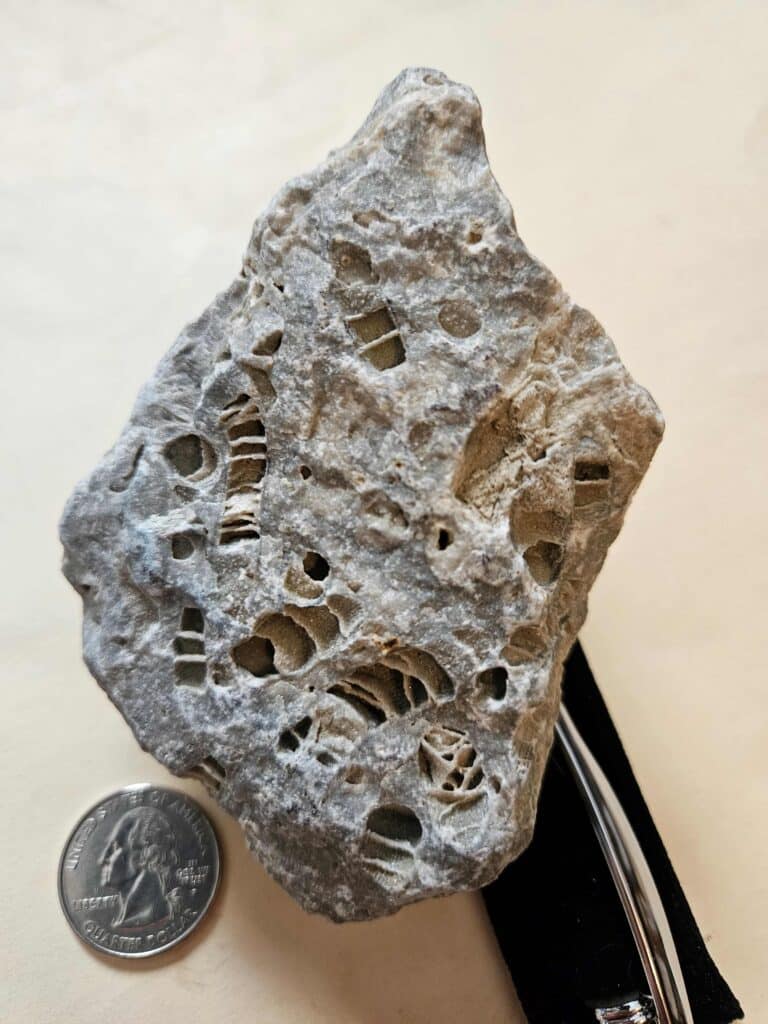
      Identification of fossil. Found this on a power line road near Hidden Lake park in Leroy. It's a piece of the limestone gravel that caught my eye. I'm guessing the gravel came from northwest Ohio where most of the limestone quarries are. Is it a species of tabulate coral? That's the closest I could find online.

      Naturalist's Response

      That’s a great photo!

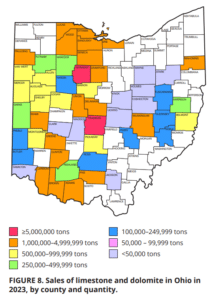
      One of the great things about taking a walk on a crushed-stone trail is that you might come across traces of ancient life just below your feet — and since the quarries of western Ohio produce huge amounts of construction-aggregate stone, there’s a good chance that your stone was quarried nearby. (Not to brag, but Ohio ranked 5th in the U.S.A. for crushed-limestone production in 2023!)

      Map of Ohio showing limestone production by county. Quarries are concentrated in the western half of the state.

      [Map of Ohio limestone production by county, via ODNR]

      You’re spot-on in identifying your stone as one of the Ohio limestones formed from the remains of ancient sea creatures that were deposited in seabeds.

      Also, great work narrowing your fossil down to one of the honeycomb-like tabulate coral fossils! Here’s a link to a great summary article about these cool, extinct sea creatures from the Ohio Department of Natural Resources.

      If you want to read more about them, here are two handy resources:

      • The book “Ohio’s Geology in Core and Outcrop” offers a superb description of the ancient environments where Ohio limestones were deposited, as well as some excellent photos from quarrying operations.
      • The book “Fossils Of Ohio” covers tabulate corals of the Ordovician, Silurian and Devonian on pages 78-83; however, the identification photos are a bit grainy in this older book.

      Thanks for sharing!

      -Naturalist Chris Mentrek

    • Steelhead at Big Creek Park?

      Question

      I'm pretty interested in Steelhead and fishing for them. After looking at maps and exploring a bit it doesn't seem like they would be able to get further up Big Creek tributaries like Jordan Creek (Chair factory Falls) or East Creek (Cascade Falls) but are they able to make it all the way to Big Creek Park? If not, are there any considerations for fish ladders?

      Naturalist's Response

      You are correct that steelhead typically cannot make it upstream if there are dams or large waterfalls blocking them. These fish may be able to make it upstream in Big Creek to Big Creek Park, but most fish likely do not venture upstream that far. Fish ladders are installed in the western United States so that salmon and trout can reach their spawning grounds. We just don’t have the right conditions in Ohio for much successful breeding, so as a result, the steelhead is a non-native fish here that is released from fish hatcheries to support a put-and-take fishery.

      -Naturalist Andy Avram

    • What’s happening with this wasp and moth?

      Question

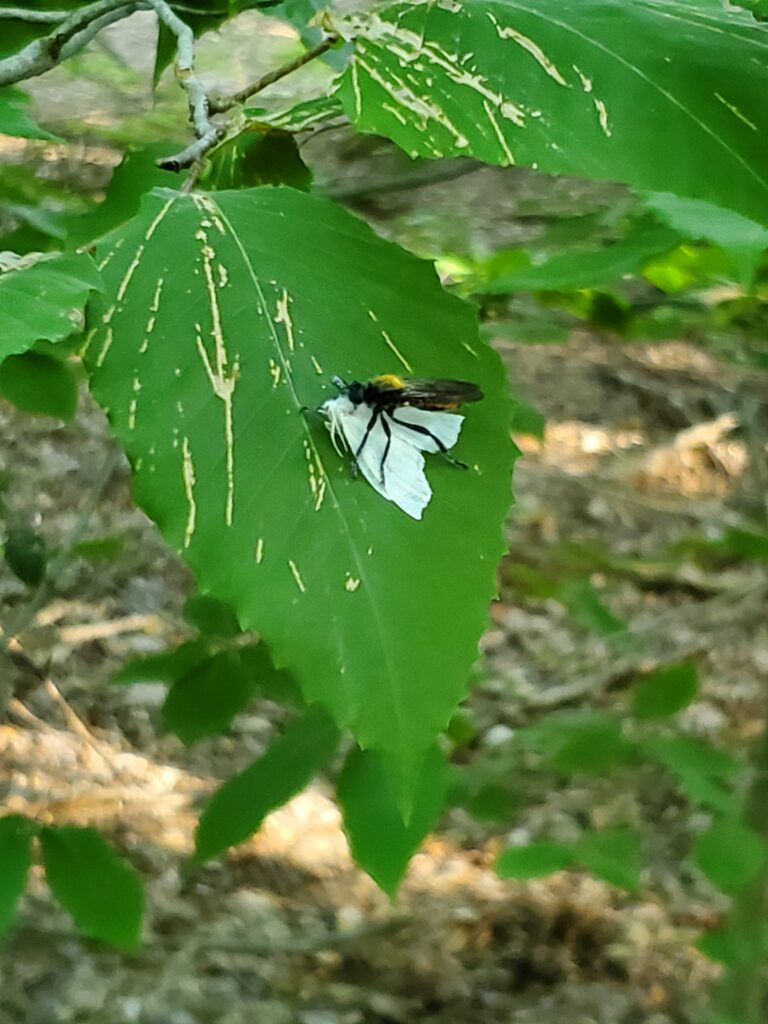
      Hi there! I hiked the Bridle Trail at the West Woods today and saw what might be a wasp pick up a small white moth, then fly up onto a leaf with it. It was such a weird thing to see that I took a picture that I'm attaching here. What on earth did I see? I stared at them for a minute but didn't perceive movement like eating or anything. I'm very curious! Hope you can help!

      Naturalist's Response

      Greetings!

      The insect you discovered is a species of robber fly. Many of the robber flies mimic bees and wasps to try and dissuade predators. However, these flies are voracious predators themselves! They capture other insects for food, such as the moth in your picture. To eat, robber flies have a powerful proboscis, which acts as a piercing straw (think how a mosquito bites you) used to suck the juices from their insect prey.

      -Naturalist Andy Avram

    • Muddy water at Walter C. Best

      Question

      We've been walking at Best Preserve over the past 3 weeks and have noticed that the water appears to be very muddy. Looks like it's coming from the pons just south of the lake. Is this detrimental to aquatic or bird life ?

      Naturalist's Response

      Thanks for your report. Yes, I have been aware of this situation since last year, and we have been working with both the Ohio Environmental Protection Agency (EPA) and our neighbors there on the concern. This past February 27, the Ohio EPA even visited Walter C. Best Wildlife Preserve to check on the situation. They spoke several times with me about it and said they are working again with Fairmount Minerals/Best Sand on the issue.

      -Park Biologist Paul Pira

    • Observatory Park hours?

      Question

      Is the observatory park open regardless of the status of the program?

      Naturalist's Response

      Thanks for your question. Yes, Observatory Park is open during different hours depending on the time of the year, and those are always current on the park’s website (above under Parks, then Observatory Park). The park is open 6 a.m. till 11 p.m. from Labor Day through Memorial Day, then 6 a.m. till 1 a.m. from Memorial Day through Labor Day. Buildings, however, are only open during programs.

    • What kind of clay can be found in the park?

      Question

      What type of clay is this in the park. It left our hands very soft!!!

      Naturalist's Response

      Hello! Looks like Nature did double duty, providing a fun experience getting your hands “dirty” while you explore and softening them at the same time!

      Northeast Ohio has glaciated soils, which means the sediments were formed in association with the glaciers of the Ice Age. The composition of the clay is generally hydrous aluminum silicate plus various impurities (see this page on the Ohio Division of Natural Resources website for more).

      From what I found, clay is used in certain types of skin cleansers to help remove dry skin, or exfoliate, and unclog pores, which is probably why your hands felt soft after handling it. However, it does absorb oils and moisture, so overtime it can actually cause skin to dry out if used often.

      Thank you for your curiosity and interest in our natural resources.  Have a great time exploring!

      -Naturalist Nora Sindelar